
· 5 min read · AI Visibility
Zero-Click Marketing: Building Demand When Google, Social Feeds, and LLMs Don’t Send Traffic
Clicks are shrinking. In 2024, 58.5% of US Google searches and 59.7% of EU searches ended without anyone clicking anything, according to SparkToro's annual zero-click study. The same dynamic applies on social and AI platforms. Founders who adapt stop chasing clicks and start building presence, trust, and recall on every surface where buyers form opinions.
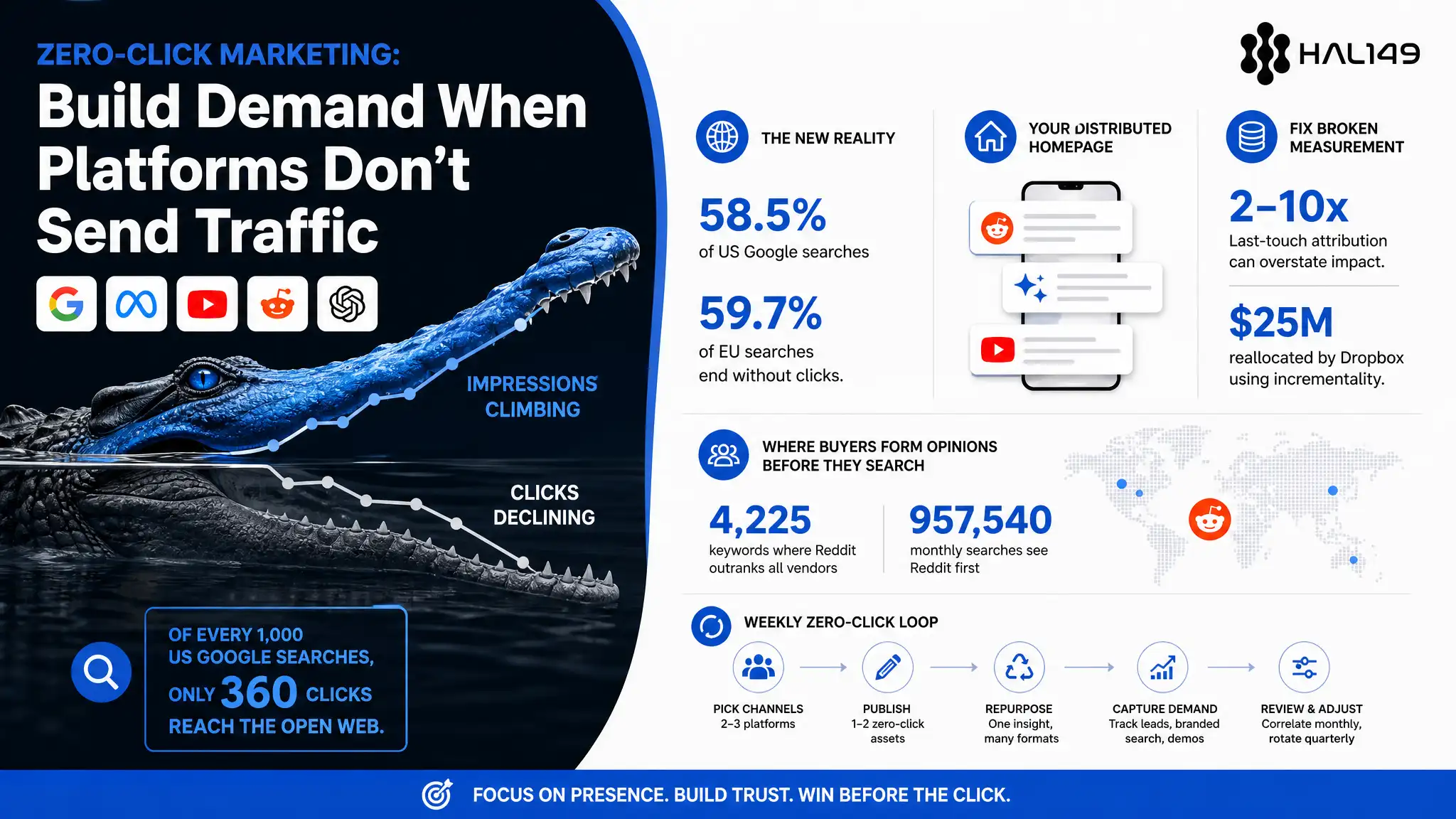
The "Alligator Graph": More Impressions, Fewer Clicks
Zero-click describes what happens when a platform answers a query without sending the user anywhere. Search is not dying: it is growing. But a rising share of searches ends on the results page itself, and that pattern now runs well beyond Google. YouTube, Amazon, Reddit, and AI tools like ChatGPT and Claude all satisfy queries in-feed before a user has any reason to visit your site.
The visual that captures this is the "alligator graph": impressions climb on one jaw, clicks decline on the other, and the jaws keep opening. Of every 1,000 US Google searches, only 360 clicks reach the open web, meaning most websites compete for a fraction of a fraction.
💡 What this means for your funnel: Organic traffic benchmarks set three years ago are no longer a reliable signal of brand health. A flat or falling traffic line can coexist with a growing audience, if that audience is seeing you in-feed.
Your Distributed Homepage
Your .com is rarely a buyer's first encounter with your brand. That encounter happens in an AI overview, a Reddit thread, a social snippet, or a review aggregator, often days or weeks before anyone types your URL. The practical implication: each of those surfaces functions as your homepage, and if your brand is absent from them, you have no homepage at all for the buyer who never clicks.
Platforms actively suppress outbound links to keep attention in-feed. Native content, posts, threads, and answers that deliver complete value without requiring a click, aligns with how algorithms distribute reach. Publishing a self-contained insight on LinkedIn or a well-sourced answer on a relevant Reddit thread reaches the audience that would never have found a link-first post, because the platform would have buried it.
The mental model that makes this operational is the deposit-to-withdrawal ratio. Every zero-click post that delivers standalone value is a deposit: it builds algorithmic reach and audience trust. A call to action (newsletter signup, demo, direct traffic) is a withdrawal. Roughly five deposits for every one withdrawal keeps the account solvent and the asks credible when they come.
How to Fix Broken Measurement
Attribution is the first casualty of zero-click. Cookie deprecation, ad blockers, multi-device journeys, privacy regulation, and "dark social" (traffic arriving from Slack, Discord, or WhatsApp and recorded as "direct" in analytics) all make last-touch models structurally unreliable.
A landmark Dropbox study published in IEEE confirmed what practitioners suspected: last-touch attribution can overstate causal impact by 2 to 10 times. Applying incrementality-adjusted profitability findings led Dropbox to reallocate approximately $25 million in spend, using geo-level blackout experiments to isolate what advertising was actually causing rather than merely correlating with.
The replacement framework tracks four layers in sequence: Audience (are you reaching the right people?), Reach (is that reach growing?), Interest (are leading indicators, branded search, email sign-ups, demo requests, rising?), and Sales (are incremental outcomes improving?). Traffic sits nowhere in this stack as a primary KPI. Correlate leading indicators with sales outcomes over rolling months; adjust channel mix quarterly based on what moves together.
Where Buyers Form Opinions before They Search
Search captures demand. It does not create it. Buyers form opinions in communities, newsletters, podcasts, and AI-cited pages, and they arrive at Google already knowing roughly what they want. Influencing that pre-search layer is what separates brands that get typed as queries from brands that get bypassed.
According to a Foundation Inc. study of 8,566 keywords across 14 major SaaS domains, Reddit outranks every vendor simultaneously on 4,225 keywords, covering 957,540 monthly searches where buyers see a Reddit thread before they see any brand. That is not a search anomaly: it is the public record, and AI language models cite the same public record when they answer buyer questions. A negative theme repeated across forum threads gets amplified into AI outputs until a brand publishes counter-evidence, real retention data, a case study, a verifiable proof point, that gives models something else to cite.
Public-record influence means participating authentically in the communities where your buyers already talk, seeding third-party mentions, and publishing proof points (data, retention stats, customer outcomes) so that search snippets and AI answers reflect your strongest narrative rather than your competitors' framing.
Running a Weekly Zero-Click Loop
Consistency beats volume. The operational structure that works is a compact weekly loop:
| Step | What to do |
|---|---|
| Pick channels | 2 to 3 platforms where your target audience actually pays attention |
| Publish | 1 to 2 zero-click assets per week, complete value, no click required |
| Repurpose | One insight becomes a post, a blog section, an email, a podcast point |
| Capture demand | Track email sign-ups, branded search volume, demo requests, direct traffic |
| Review and adjust | Correlate indicators with sales monthly; rotate channels quarterly |
A sustainable intake process, treating content as a service rather than an output, gives every asset a clear business job before it is written. The questions worth answering before publishing any piece: who is the audience, what is the job-to-be-done, what action does it support (a sales win, a support deflection, a pipeline stage), and how long before it needs a refresh. That framing stops content from being created for its own sake and keeps every asset doing measurable work.
More updates
· Engineering
The Case for AI-Native Companies
AI-native companies produce roughly 100x the output of legacy firms that adopt AI on top of old hierarchies. Here is why organizational design, not software, is the deciding factor.
Read update · 6 min read
·
GTM Engineering and Growth Engineering Are Not the Same Role
GTM engineering automates revenue systems outside the product. Growth engineering runs experiments inside it. Here is where each discipline starts and stops.
Read update · 3 min read
· Product
Design of a webapps factory as a separate project
Design work on a factory for small, niche web apps. Two conclusions: it has to be a separate product from our client platform, and the slow part is not the code.
Read update · 1 min read