
· 6 min read · Engineering
The Case for AI-Native Companies
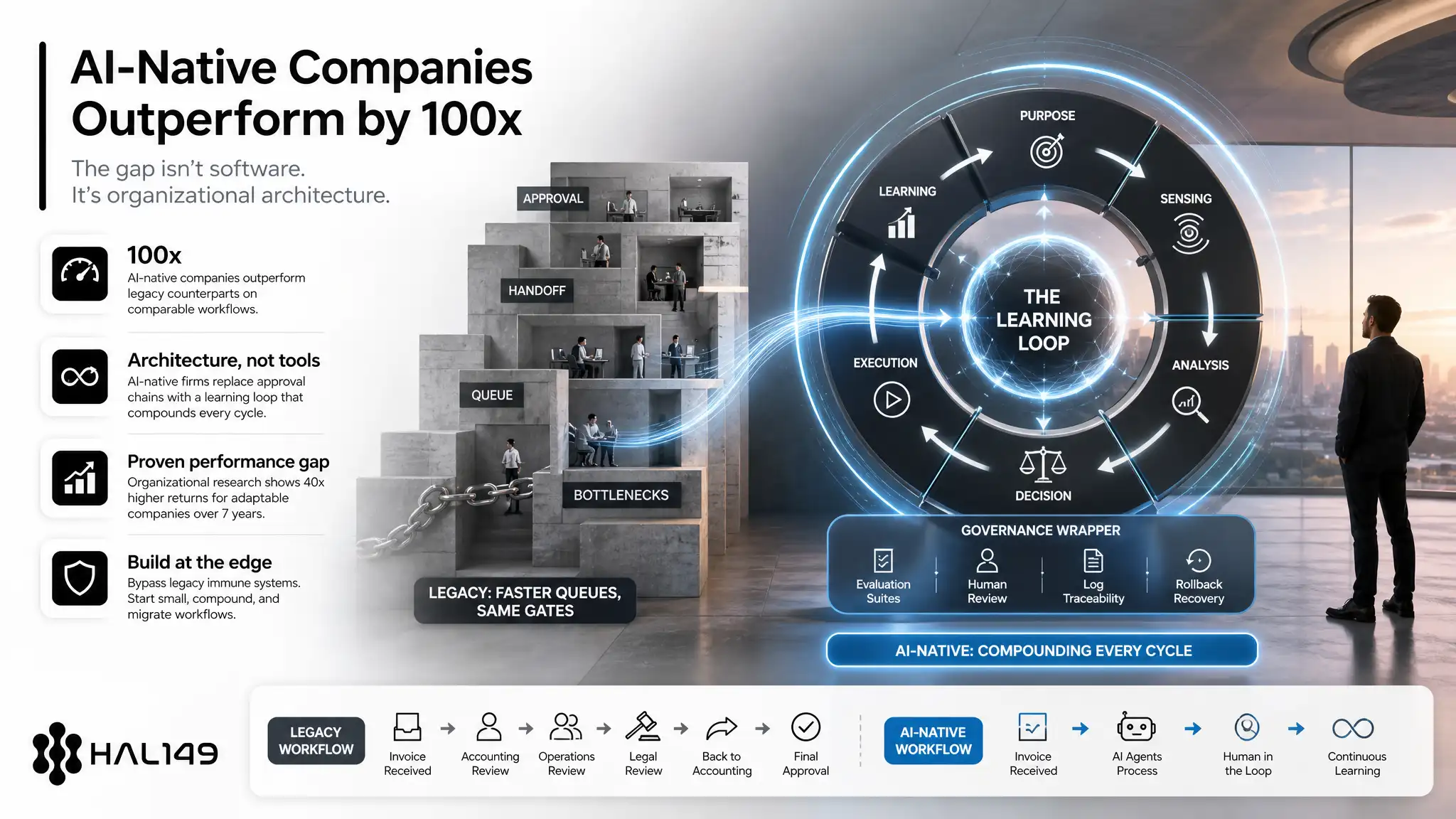
AI-native companies are already outperforming their AI-adopting legacy counterparts by roughly 100 times on comparable workflows. The gap is not a software gap. It is an organizational architecture gap: companies that redesign their operations around AI from the ground up eliminate every human bottleneck that legacy structures preserve and accelerate.
Why Cramming AI into Legacy Structures Fails
The standard approach to AI adoption fails for the same reason that early television failed: the first broadcasters put radio announcers reading radio scripts in front of a camera. The medium changed; the format did not.
Most enterprises today are inserting AI into hierarchies that were designed around a principle formulated in 1937. Coase's Law, named for economist Ronald Coase's paper "The Nature of the Firm", held that coordination and execution costs are cheaper inside a company than outside it. That assumption justified every layer of human approval, every committee, every ticket system built since. It is now obsolete.
Today it is cheaper to build a product feature than to have the meeting about building it. Execution costs outside the organization, using AI tools, are lower than execution costs inside it. When you pump AI into a legacy structure, you do not remove the bottlenecks: you accelerate the handoffs between them. Invoice processing is a clear case: in a legacy system, an invoice moves through accounting, operations, legal and back to accounting, with a human approval at every node. Automating each node individually still leaves the structure intact. You have faster queues feeding the same gates.
What AI-Native Architecture Actually Looks like
A genuinely AI-native organization replaces the human-centric approval loop with an agent-driven feedback engine. Salim Ismail, founder of OpenExO and author of The Organizational Singularity, describes a six-layer stack as the core:
| Layer | Function |
|---|---|
| Purpose | Encodes the company's mission and ethical boundaries as a machine-readable protocol, not a wall poster |
| Sensing | Continuously monitors the external environment for competitive signals and market changes |
| Analysis | Interprets signals, sizes threats and opportunities, identifies affected channels |
| Decision | Weighs options (ignore, compete, partner, acquire) with human judgment above the loop |
| Execution | Implements the chosen response, including sourcing partners or negotiating deals |
| Learning | Measures loop duration and quality, and asks how to improve it next time |
A governance wrapper runs around the entire stack: every agent requires evaluation suites, a human review queue, log traceability and rollback recovery. Agents, like junior employees, can lose context or go off-track, and the architecture has to account for that.
The critical property of this design is the learning loop. Every cycle through the stack produces a structured question: how do I run this faster, cheaper and more reliably next time? At the workflow level, that is a practical, achievable form of recursive self-improvement, and it compounds. An invoice processing system running this loop goes from handling a thousand invoices a month to roughly 100,000.
How Large the Performance Gap Actually Is
The 100x figure comes from observing AI-native firms operating fully within this model against legacy organizations running AI tools on top of old structures. On equivalent workflows, the gap is approximately one order of magnitude on top of another.
That number has a precedent in organizational research. A seven-year study tracking Fortune 100 companies against the Exponential Organizations framework found that the ten most flexible and adaptable companies delivered 40 times the shareholder returns of the ten least flexible, over the same period. The performance difference between adaptable and rigid organizations is not marginal. It is structural, and it widens as the external environment accelerates.
The same logic applies with greater force today, because the cost of AI has collapsed. You can spend $20 a month or a million dollars a month and get broadly equivalent model capability. That asymmetry means the advantage of AI-native design is now available to any organization, not just those with the largest R&D budgets.
💡 Architect around the loop, not the tool: The difference between AI adoption and AI-native operation is whether your workflow has a learning loop that improves every time it runs. Adding an AI tool to an existing process is adoption. Rebuilding the process so that AI closes the loop and asks how to shrink it on the next cycle is architecture. The second approach compounds; the first plateaus.
Is There a Path for Legacy Organizations?
Yes, but it requires building at the edge rather than transforming the core. Every large organization has an immune system: its structures are designed for efficiency and predictability, not adaptability, and a disruptive initiative inside the core will be rejected. The answer is not to fight that immune system but to bypass it.
Nespresso is the example Ismail returns to. Nestlé incubated it as a line of business inside the standard operating company for ten years, where it fit nowhere, before the CEO gave it a separate building and let it run independently. The result became one of the company's highest-margin lines. The same logic drove Google's restructuring into Alphabet: decentralizing the edges rather than coordinating everything from the center.
For a legacy organization, the practical sequence is:
- Run an immune system process that prevents the legacy core from attacking the new initiative.
- Build the AI-native engine at the edge, starting with one or two workflows: invoice processing, demand forecasting, content management.
- Let the learning loop compound. Once recursive self-improvement is established at the workflow level, the new edge begins to outperform the legacy core on those functions.
- Gradually migrate workflows from the core to the edge until the old structure can be deprecated.
For organizations under roughly 50 people, where the founder knows everyone, brute-force rebuilding is possible. Above that threshold, the immune system problem is real enough to require a structured intervention before the edge-building can start.
What This Means for Those Entering the Field Now
The practical implication for anyone building skills today is that computer science and engineering backgrounds become more valuable in an AI-native world, not less. Someone with a grounding in software systems has better judgment about what AI agents are actually doing, how to guide them, and where they fail, than someone who has only ever used AI as an end-user.
The shift is in orientation: the task is no longer to write every line yourself, but to architect systems where agents handle the cognitive workload and you make the judgment calls that sit above the loop. Ismail describes writing his third book in three months of what he calls "pure joy" compared to three years of difficulty for the first, because AI handled all the structural cognitive work (where does this quote fit, how does this chapter connect) while he focused on judgment and creative direction.
That same shift applies to every software project and every workflow. The question is not which AI tool to use. It is whether the system you are building has a learning loop that makes it measurably better every time it runs.
For more on this topic watch "Why AI-Native Companies Are 100X Better - And Yours Isn't One | Salim Ismail".
More updates
·
GTM Engineering and Growth Engineering Are Not the Same Role
GTM engineering automates revenue systems outside the product. Growth engineering runs experiments inside it. Here is where each discipline starts and stops.
Read update · 3 min read
· Product
Design of a webapps factory as a separate project
Design work on a factory for small, niche web apps. Two conclusions: it has to be a separate product from our client platform, and the slow part is not the code.
Read update · 1 min read
· Product
Countermeasures against prompt injection in our AI agent
Our AI agents are being probed for their system prompts. The refusal holds, but nothing was detecting, logging or throttling those attempts.
Read update · 2 min read