
· 3 min read ·
GTM Engineering and Growth Engineering Are Not the Same Role
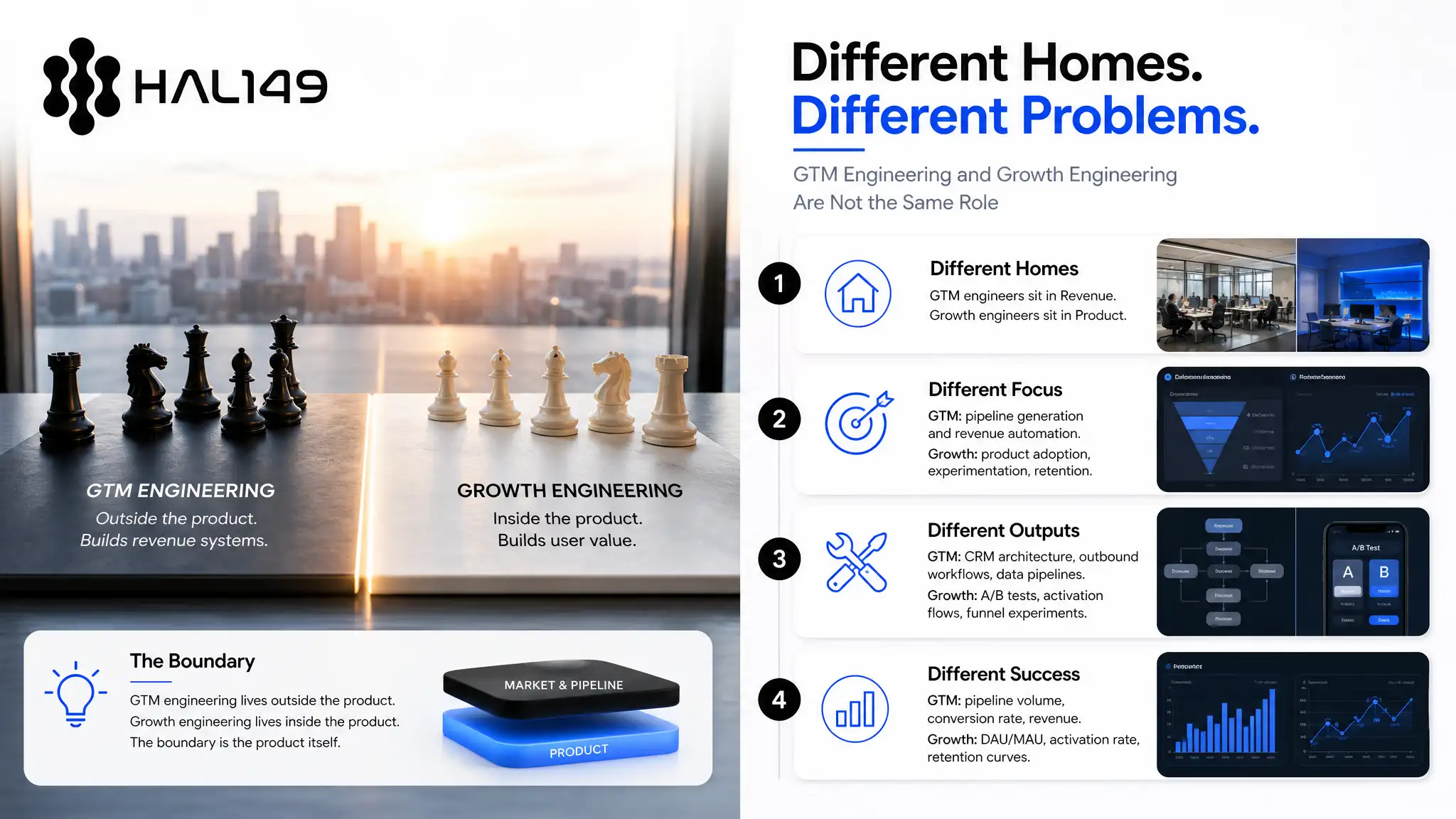
GTM engineering and growth engineering overlap just enough to cause real confusion, but they operate in different organizational homes on different problems. GTM engineering builds and automates the systems that generate pipeline and move revenue: CRM architecture, outbound workflows, data enrichment, and signal-based triggers. Growth engineering sits inside the product, running experiments that improve adoption, retention, and conversion.
The Core Distinction: System Vs. Product
GTM engineering owns the infrastructure that surrounds the product and drives revenue. Think of it as the technical layer between your market and your pipeline: the integrations connecting your CRM to enrichment tools, the AI workflows that qualify and route leads, the outbound sequences triggered by buying signals. The job is to make revenue motions scalable and automated without adding headcount.
Growth engineering owns the product experience itself. Growth engineers design A/B tests, optimize activation flows, study funnel drop-off data, and build features that improve how users discover value inside the product. According to Productboard, growth engineers are "responsible for user acquisition, retention, and overall business growth" by optimizing the product experience directly, while product engineers focus on the product's core functionality.
The boundary between the two is the product itself. GTM engineering lives outside it; growth engineering lives inside it.
Where Each Discipline Sits in the Organization
The organizational home makes the difference concrete. As Anfloy's comparison of the two roles shows, growth engineers report into product and growth teams, while GTM engineers sit inside the revenue organization alongside sales, marketing, and customer success.
| Dimension | GTM Engineering | Growth Engineering |
|---|---|---|
| Org home | Revenue / GTM team | Product / Growth team |
| Primary focus | Pipeline generation, revenue automation | Product adoption, experimentation, retention |
| Key outputs | CRM architecture, outbound workflows, data pipelines | A/B tests, activation flows, funnel experiments |
| Collaborators | Sales, marketing, RevOps, customer success | Product managers, designers, data scientists |
| Success metric | Pipeline volume, conversion rate, revenue | DAU/MAU, activation rate, retention curves |
What GTM Engineers Actually Build
A GTM engineer designs and automates the systems that turn go-to-market strategy into measurable execution. According to the Revenue Operations Alliance, a GTM engineer directly builds and implements technical solutions, while a growth product manager only coordinates with engineering teams. That distinction matters: the GTM engineer is a builder, not a coordinator.
In practice, the work spans four disciplines: revenue operations, marketing operations, data engineering, and, increasingly, prompt engineering to deploy AI agents inside sales and marketing workflows. The systems they build automate what sales and marketing teams used to do manually: prospecting, enrichment, scoring, routing, and follow-up.
💡 Practical test: If the work changes how prospects experience the pipeline (CRM, outbound, routing), it is GTM engineering. If it changes how users experience the product (onboarding, activation, in-app flows), it is growth engineering. When the same team owns both, the company is usually early-stage and has not yet separated the two motions.
Is There Overlap between the Two?
Yes, but it is narrower than it appears. Both disciplines are metrics-driven, both use experimentation, and both touch conversion rate as a shared metric. A GTM engineer optimizing the conversion from MQL to SQL and a growth engineer optimizing the conversion from free to paid are using the same analytical toolkit on adjacent problems.
The overlap is highest at the point where product-led growth (PLG) meets traditional GTM. In a PLG company, the product is part of the acquisition motion, so growth and GTM engineers sometimes share the same funnel stage. But even there, the systems they build are distinct: one builds the in-product experience, the other builds the revenue infrastructure around it.
Neither role replaces the other. A company that has sophisticated revenue automation but no product experimentation, or vice versa, is leaving measurable growth on the table.
HAL149's GTM Engineering work sits firmly in the first column of the table above: building the systems that generate and qualify pipeline, automate outbound and inbound motions, and connect revenue data across the stack. If that is the gap you are looking to close, the Updates section tracks what is shipping and what is currently available.
More updates
· Engineering
The Case for AI-Native Companies
AI-native companies produce roughly 100x the output of legacy firms that adopt AI on top of old hierarchies. Here is why organizational design, not software, is the deciding factor.
Read update · 6 min read
· Product
Design of a webapps factory as a separate project
Design work on a factory for small, niche web apps. Two conclusions: it has to be a separate product from our client platform, and the slow part is not the code.
Read update · 1 min read
· Product
Countermeasures against prompt injection in our AI agent
Our AI agents are being probed for their system prompts. The refusal holds, but nothing was detecting, logging or throttling those attempts.
Read update · 2 min read