
· 6 min read · Analysis
Static Websites Are Becoming a Legacy Format, Here Is What Replaces Them
A website designed as an autonomous agent responds to what a visitor actually asks, qualifies their intent in real time, and connects to live business data, all without waiting for a human. That is the core of the agentic web: not a chatbot bolted onto a landing page, but an entire site built, from its architecture up, to function as an intelligent, interactive system.
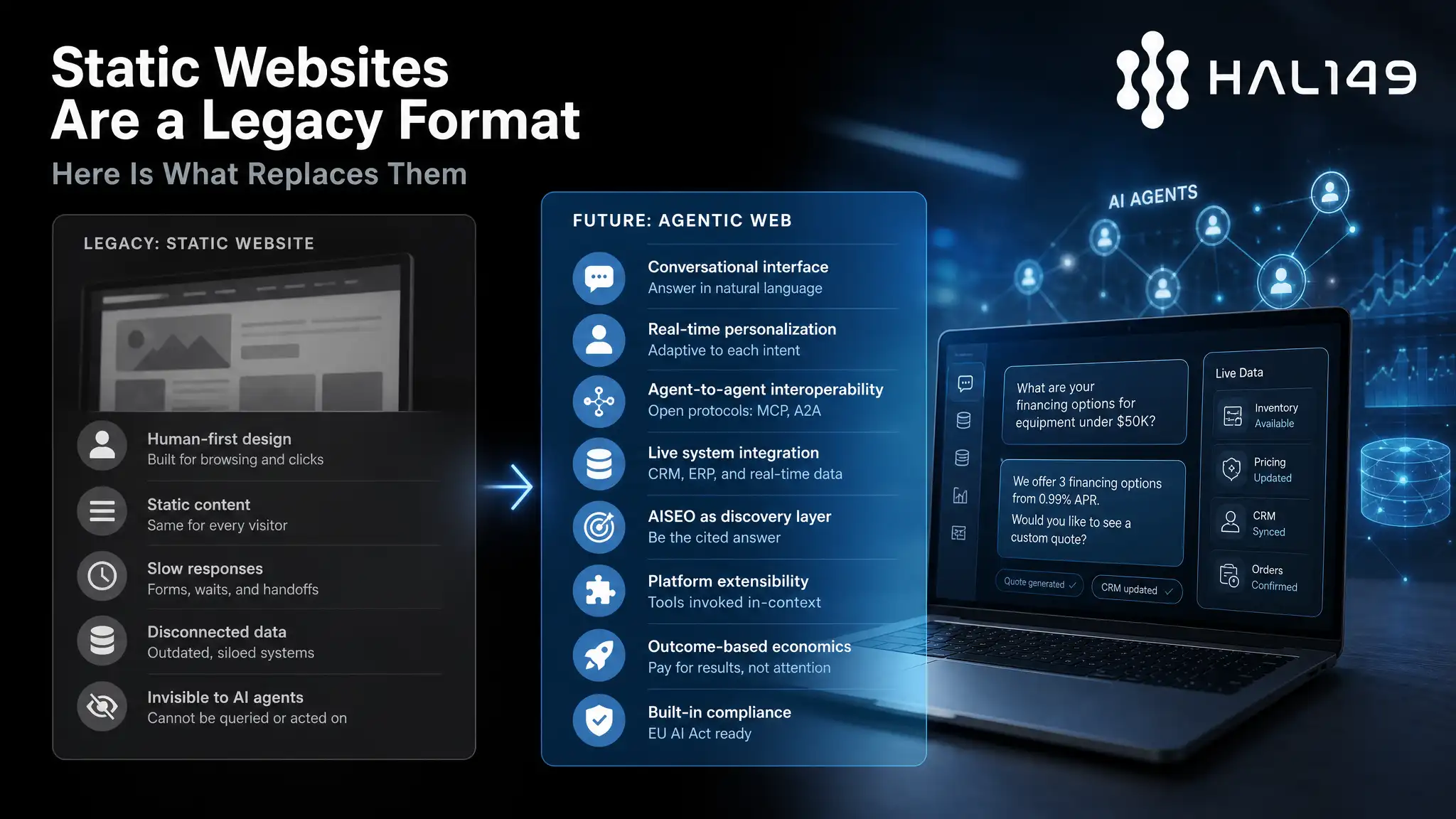
Why the Static Page Is Starting to Look like a Legacy Format
For three decades, every assumption baked into web design flowed from one kind of visitor: a person with eyes, limited patience, and a mouse. Navigation menus, forms, and landing pages all exist to guide that person through a funnel.
Two things shifted simultaneously. Visitors now expect to state a question in plain language and get an immediate answer, the way they do with a conversational AI tool. A navigation menu and a buried phone number feels, increasingly, like being handed a paper map.
And a second kind of visitor started arriving: software. AI agents that arrive on behalf of a user, read what is on a page, and act. They do not scroll. They do not respond to hero images. They query, and if a site cannot be queried, they move to one that can.
💡 Design implication: A site that cannot be queried by an external AI agent is invisible to an expanding share of automated procurement and discovery. Structured, agent-readable data is no longer optional infrastructure.
What an Agentic Web Actually Is
The phrase operates at two scales, and keeping them separate matters.
At the macro scale, an agentic web describes a new phase of the internet: a transition from a browsable, human-read web toward a mesh of autonomous agents that interpret goals, make decisions, and transact over open protocols. Machine-to-machine infrastructure, not a content library.
At the micro scale, where this work lives, the question is what a single website looks like as a node in that mesh. The answer is that the site stops being content and becomes an agent. Not a conversational widget added to a corner of a page, but a system designed from the architecture up to know the business, respond in real time, qualify intent, make recommendations, and hand off to a human only when one is genuinely needed.
That distinction, a site designed as an agent versus a site with an assistant added, is the meaningful one. Almost everything in the market today is the second thing positioned as the first.
The Eight Dimensions that Make This a Category, Not a Feature
The agentic web spans eight distinct dimensions, and its value comes from all of them operating together rather than any one in isolation.
| Dimension | What it does |
|---|---|
| Conversational interface | Visitor states intent in natural language; site answers directly without page navigation |
| Real-time personalization | Response adapts to what the visitor actually says, not to a segment or a cookie |
| Agent-to-agent interoperability | Site exposes structured data over emerging standard protocols (MCP, A2A) so external agents can read and act on it |
| Internal system integration | Agent connects to live CRM and ERP data, so the site reflects the actual state of the business |
| Closed-loop content engine | System formulates content strategy, publishes optimized for search and answer engines, measures what converts, and adjusts |
| AISEO as discovery layer | Site is architected to be the cited answer when someone asks an AI engine about the industry |
| Platform extensibility | Vertical tools (configurators, diagnostics, valuations) invoked mid-conversation when the agent detects the right intent |
| Outcome-based economics | The model shifts from monetizing attention to delivering qualified outcomes at the marginal cost of inference |
Building only the first dimension produces a capable chatbot. The claim behind the agentic web is that the combination is a different category altogether.
The Economics behind the Shift
The economic dimension is what moves the conversation from "interesting" to "urgent."
The traditional web monetizes attention: pay to place an ad, pay for a click, pay a human to qualify and close the resulting lead. The agentic web monetizes outcomes: the agent delivers the answer, qualifies intent, and prepares the transaction inside the conversation, at the marginal cost of a few tokens.
That cost has already collapsed. The price of GPT-4-class inference dropped by more than 99% over three years, according to the Stanford AI Index 2025. A permanent conversational agent on a small business website went from an enterprise luxury to a rounding error in operating costs. When a full qualification conversation costs a fraction of a cent in compute, and a salesperson doing the same costs salary, time, and limited hours, the comparison does not require a spreadsheet.
Why the Timing Is Right Now
Three structural conditions had to be true simultaneously for the agentic web to be buildable rather than merely describable. As of mid-2026, all three hold.
The protocols standardized. The MCP registry had approached 10,000 indexed servers by May 2026, with the A2A protocol attracting broad adoption alongside it. A site can now be a genuine node in an agent ecosystem rather than an isolated silo.
The discovery layer shifted. A growing share of searches now end in AI-generated answers rather than clicks on blue links. Being the source an AI engine cites matters more than ranking a traditional result. Static pages do not meet that bar; a site architected for agent readability can.
Regulation created a deadline. The EU AI Act's transparency obligations under Article 50 took effect on 2 August 2026. Any business operating an autonomous agent in the EU that did not build compliance in by default now has a problem. Compliance-by-design is an advantage, not a cost.
What the Market Forecasts Say
The market projections are large enough to deserve a direct look, alongside their assumptions.
Morgan Stanley Research estimates that agentic shoppers could account for $190 billion to $385 billion in US e-commerce spending by 2030. Gartner's top strategic prediction for 2026 places 90% of B2B buying as AI-agent-mediated by 2028, channeling more than $15 trillion through agent exchanges.
A business with no agent-readable layer simply does not participate in that volume. It will not be that the site converts poorly; it will be that the site is not consulted at all.
The upside cases in those forecasts depend on websites becoming transaction endpoints that other agents buy from directly, which is still contingent. But the direction is visible enough that positioning for it now carries a lower cost than catching up to it later.
More updates
· Engineering
The Case for AI-Native Companies
AI-native companies produce roughly 100x the output of legacy firms that adopt AI on top of old hierarchies. Here is why organizational design, not software, is the deciding factor.
Read update · 6 min read
·
GTM Engineering and Growth Engineering Are Not the Same Role
GTM engineering automates revenue systems outside the product. Growth engineering runs experiments inside it. Here is where each discipline starts and stops.
Read update · 3 min read
· Product
Design of a webapps factory as a separate project
Design work on a factory for small, niche web apps. Two conclusions: it has to be a separate product from our client platform, and the slow part is not the code.
Read update · 1 min read