
· 5 min read · Analysis
Organic Search Traffic Is Shrinking Fast, and AI Overviews Are Why
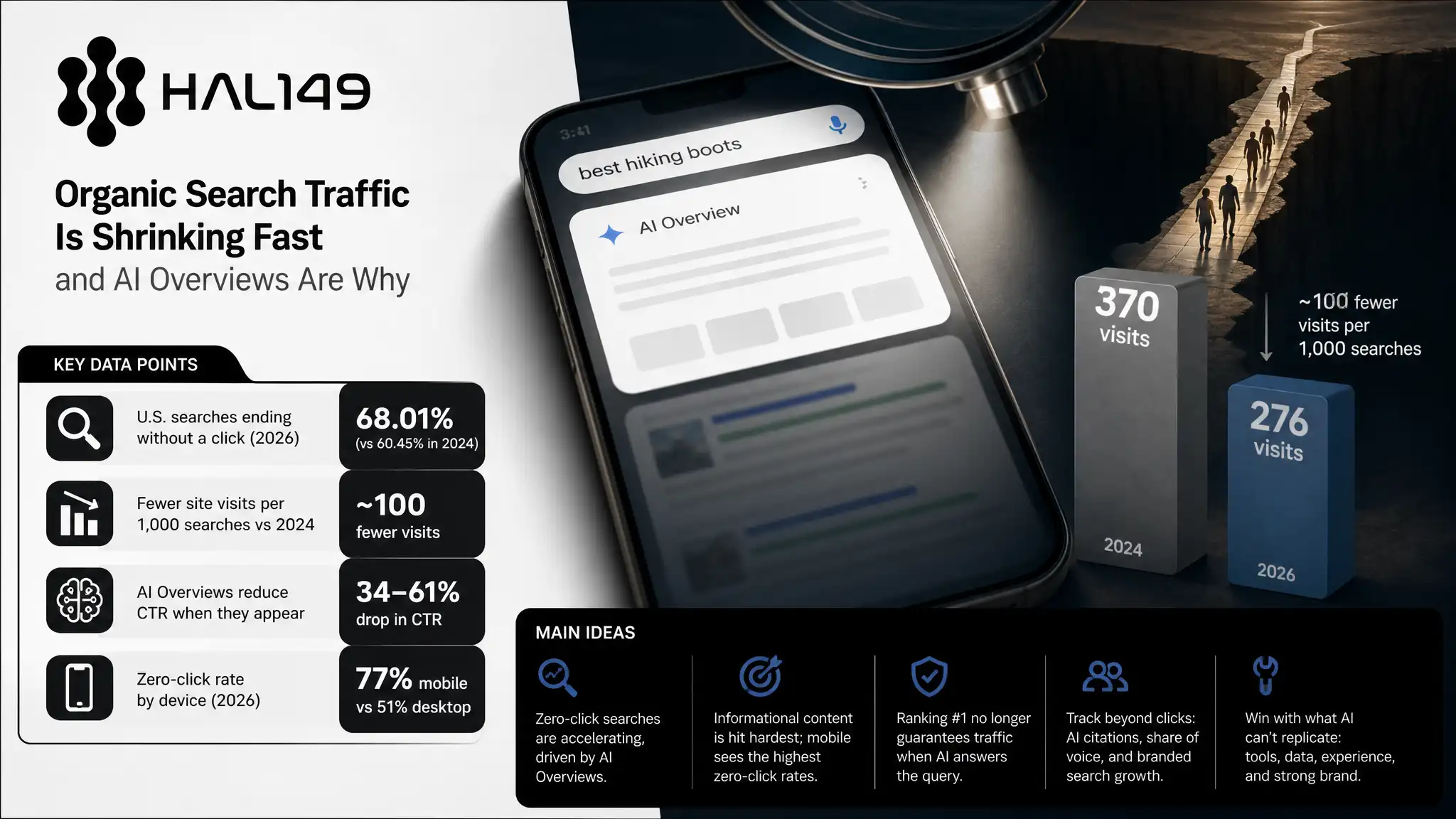
More than two-thirds of Google searches now end without a single click to any website. According to SparkToro and Similarweb, 68.01% of U.S. searches ended without a click in the first four months of 2026, up from 60.45% in 2024. AI Overviews are the primary accelerant, cutting organic click-through rates by 34-61% on the queries where they appear.
The Scale of the Zero-Click Shift
Zero-click search is not new, but its rate of growth has sharply accelerated. About 45% of searches ended without a click a decade ago. By 2019 that figure was roughly 50%. Today it stands at approximately 68%, with the steepest two-year jump in the trend's history occurring between 2024 and 2026.
The practical translation: of every 1,000 Google searches, only around 276 now reach the open web. Two years ago, roughly 370 of those same 1,000 searches did. That is nearly 100 fewer chances per thousand for any website to receive a visitor, lost in just two years.
The pattern is not uniform across query types. Informational searches, the type that most editorial and blog content is written to capture, show the highest zero-click rates. Transactional and commercial-investigation queries, where a user intends to buy or compare, are more likely to still produce a click. Mobile devices, which account for the majority of Google searches, show a zero-click rate of around 77%, compared with roughly 51% on desktop.
AI Overviews Gaining Speed
AI Overviews (the summaries Google generates and displays above organic results) are now the single biggest structural driver of the acceleration. They appear on more than 20% of all Google searches, and their share is considerably higher on categories like health, finance and technology.
The CTR impact when they appear is severe. Ahrefs research from December 2025, based on 300,000 keywords, found a 58% reduction in click-through rate for the top-ranking result when an AI Overview is triggered. An earlier analysis from April 2025 by the same team put the reduction at 34.5%, meaning the effect has grown substantially in the intervening months.
A separate large-scale study by Seer Interactive, covering 5.47 million queries across 53 brands and 2.43 billion organic impressions, found that organic CTR fell 61% on queries where AI Overviews appear, dropping from 1.76% to 0.61%. Position-one results are not insulated: their CTR can fall from around 32% to around 20% when an AI Overview is present.
Being cited inside an AI Overview does not reliably protect a site's traffic either. A page can be referenced as a source in the summary and still receive near-zero incremental clicks, because the majority of users who see the AI Overview read the answer and leave without following any of its links.
What This Means for a Business That Depends on Google
Ranking is no longer the same as being found. The SEO assumption that a high organic ranking translates predictably into visitors and revenue is breaking down. A business can hold position one on a competitive informational keyword and still see traffic fall quarter over quarter, because the query type attracts AI Overviews that answer the question in place.
The sites absorbing the worst outcomes are those whose content is primarily informational: how-to guides, listicles, comparison articles, definitional posts. Industry case studies from 2025 and 2026 cite traffic losses of 20-40% on this content category, with some niches reporting larger drops. Mid-size publishers, those without the brand authority that keeps users typing their names directly into a search bar, are hit hardest. Large platforms with strong brand queries and owned SERP features (Wikipedia, Reddit, major news brands) are holding up better by comparison.
💡 Strategist's note: The queries most likely to survive the zero-click era are those where the user needs something Google cannot deliver inside a summary: a specific tool, a real transaction, a community, a proprietary dataset, or a distinctive point of view they associate with a particular brand. Content that merely conveys information a language model can synthesize is the most exposed.
Signals and Metrics Worth Tracking Now
Because clicks no longer reliably represent reach, the measurement frameworks built around organic traffic are giving an increasingly incomplete picture.
Three metrics are becoming standard complements to traditional click and ranking data. The first is AI citation rate: how often a brand's content is referenced within AI Overviews and other AI-generated answers. The second is share of voice inside AI answers relative to competitors on key queries. The third is branded search volume as a proxy for top-of-funnel influence: a brand that is present in AI answers may see branded direct searches grow even as unbranded organic clicks decline.
Tracking these alongside conventional GSC data gives a more accurate view of actual visibility in the current search environment.
The Strategic Adjustments That Follow
The broad implication is that Google organic, as a standalone acquisition channel, carries more risk than it did two or three years ago. Businesses built primarily on informational content attracting unbranded traffic are the most exposed. The diversification logic follows directly: email lists, community platforms, social distribution, paid channels and direct brand-building all become structurally more valuable when Google's referral tap is narrowing.
For content itself, the types that retain or grow clicks despite AI Overviews share a common property: they offer something the summary cannot replicate. Original research with proprietary data, interactive tools, calculators, configurators, and content that reflects genuine experience rather than synthesized information all tend to hold their click value better. A strong brand identity, one that makes a user want specifically your site and not just an answer to a question, is increasingly the differentiating asset between sites that keep their audience and those that quietly lose it to on-SERP answers.
The trajectory of the data through 2024-2026 suggests this is not a temporary adjustment. The zero-click share grew by more than seven percentage points in two years. AI Overviews are still expanding in coverage and query depth. Planning content and traffic strategy around the assumption that Google will restore its referral volumes is, at this point, a position the data does not support.
More updates
· Engineering
The Case for AI-Native Companies
AI-native companies produce roughly 100x the output of legacy firms that adopt AI on top of old hierarchies. Here is why organizational design, not software, is the deciding factor.
Read update · 6 min read
·
GTM Engineering and Growth Engineering Are Not the Same Role
GTM engineering automates revenue systems outside the product. Growth engineering runs experiments inside it. Here is where each discipline starts and stops.
Read update · 3 min read
· Product
Design of a webapps factory as a separate project
Design work on a factory for small, niche web apps. Two conclusions: it has to be a separate product from our client platform, and the slow part is not the code.
Read update · 1 min read