
· 4 min read · Analysis
Generalists Are Winning Again, and AI Explains Why
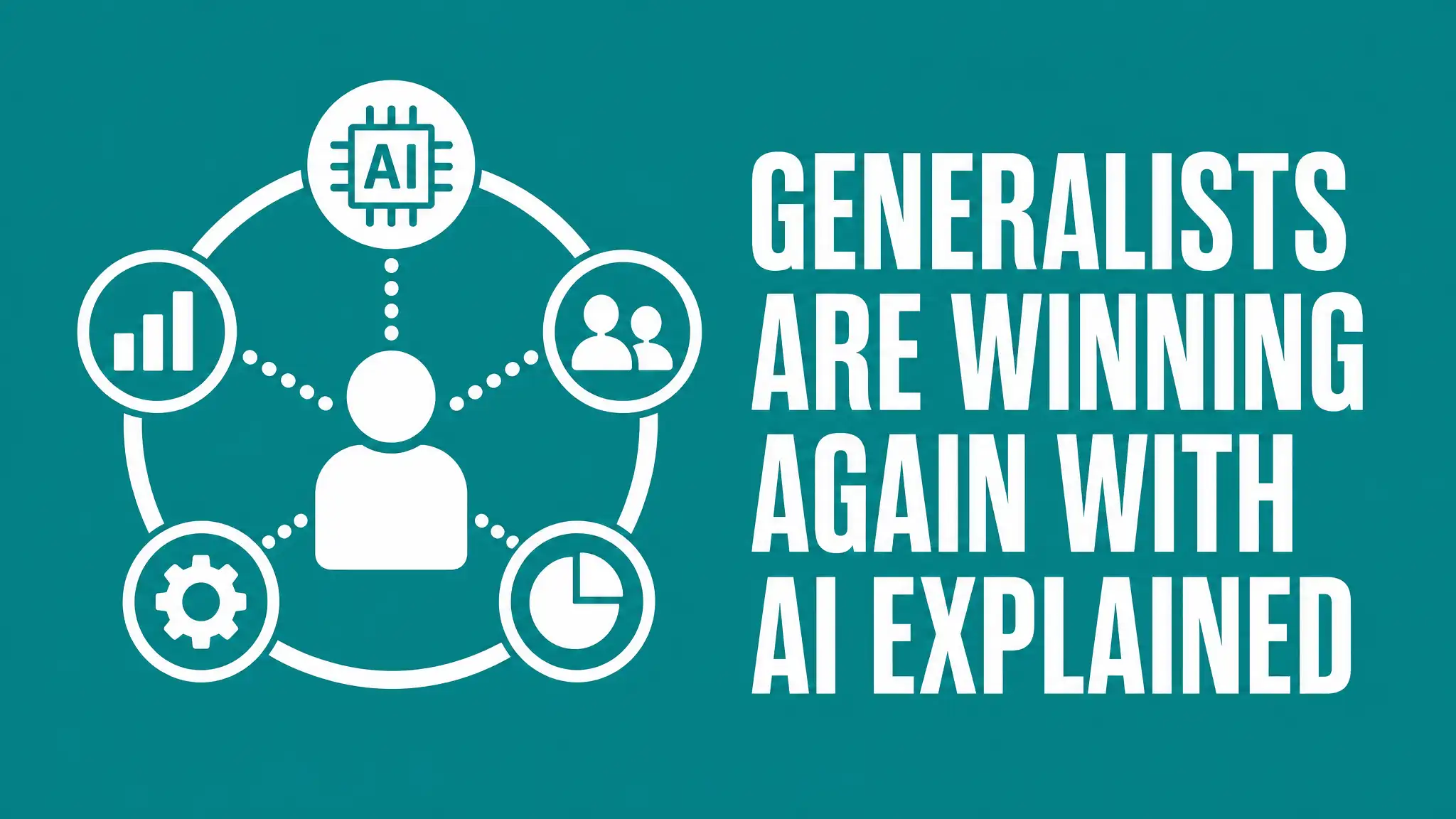
AI does not behave like a specialist's tool locked to one function. It integrates complete processes that previously required multiple coordinated experts, which means the professionals best positioned to use it are those who understand systems, not silos. Hyper-specialization, the career strategy that dominated the last two centuries, is now a structural vulnerability rather than a shield.
Why Hyper-Specialization Is Losing Its Edge
For most of modern business history, deep mastery of a narrow domain was the safest professional bet. Large corporations and bureaucracies were built around it: marketing, data, product, design, and sales each developed their own languages, metrics, and career ladders.
That architecture worked when information was scarce and human coordination was the only mechanism for connecting areas. Each specialist held a piece that no one else could replicate quickly. AI has dissolved that scarcity almost overnight.
Hyper-specialists often find themselves more vulnerable to automation or industry shifts because their roles are easier to replace when technology catches up or markets evolve. The narrower the function, the more completely an AI system can substitute for it, because narrow functions are precisely what AI models are easiest to train against.
How Most People Are Learning AI Wrong
The majority of professionals who have picked up AI tools use them to speed up what they already did: rewriting emails a little faster, summarising documents, generating first drafts of slide decks. That is not a transformation; it is an acceleration of the old workflow.
The deeper problem is the absence of a mental model. Without understanding how automation actually works, or what the real decision points of a language model are, even frequent users hit a ceiling. They remain anchored in the idea of doing what they did before, only faster.
Companies compound this by segmenting AI learning by role, treating it as yet another vertical specialisation. That framing misses the point. Workforce success will not be defined by a single skill but by the ability to integrate across disciplines and work with AI systems, according to the World Economic Forum's analysis of educational priorities for the next decade.
💡 Practical test: Before your next AI task, write out the complete process you are trying to automate, end to end, across every team it touches. If you cannot draw that map, you are not yet ready to automate it well.
AI as the Connective Tissue between Disciplines
AI is most powerful when it is used as connective tissue between disciplines, not as a productivity booster inside a single one. It can translate the output of a data pipeline into a format a product team acts on, connect a customer-service pattern to a supply-chain decision, or compress a compliance review into a brief that a generalist executive can respond to in an hour.
When AI executes tasks, the comparative advantage shifts to those who can frame the right problems and align human systems to execute on strategy, capabilities that sit in the space between disciplines, not inside any one of them.
The phenomenon is what McKinsey refers to as "T-shaped" leadership: a deep understanding of at least one function, but the ability to operate across disciplines, not jack-of-all-trades, but master of integration.
What the New Generalist Actually Looks like
Being a generalist in the AI era does not mean knowing a little about everything. The definition has shifted. A new generalist knows enough about several domains to recognise how AI outputs in one domain can become inputs in another, and designs systems around those connections.
AI and big data top the list of fastest-growing skills in the World Economic Forum's Future of Jobs Report 2025, with employers expecting 39% of key job skills to change by 2030. The skills rising alongside AI literacy are not deeper technical specialisations; they are resilience, creative thinking, and cross-disciplinary communication.
These professionals have a concrete structural advantage. They detect opportunities that specialists working in silos never see, because the opportunity usually lives in the gap between functions. They design solutions that do not require an extended handoff chain to execute. And they iterate faster because they control the complete system rather than waiting for sign-off from adjacent teams.
The specialist trains the model. The generalist builds the system that puts ten models to work together.
More updates
· Engineering
The Case for AI-Native Companies
AI-native companies produce roughly 100x the output of legacy firms that adopt AI on top of old hierarchies. Here is why organizational design, not software, is the deciding factor.
Read update · 6 min read
·
GTM Engineering and Growth Engineering Are Not the Same Role
GTM engineering automates revenue systems outside the product. Growth engineering runs experiments inside it. Here is where each discipline starts and stops.
Read update · 3 min read
· Product
Design of a webapps factory as a separate project
Design work on a factory for small, niche web apps. Two conclusions: it has to be a separate product from our client platform, and the slow part is not the code.
Read update · 1 min read