
· 5 min read · Analysis
Integrating AI into Business Workflows that Actually Exist
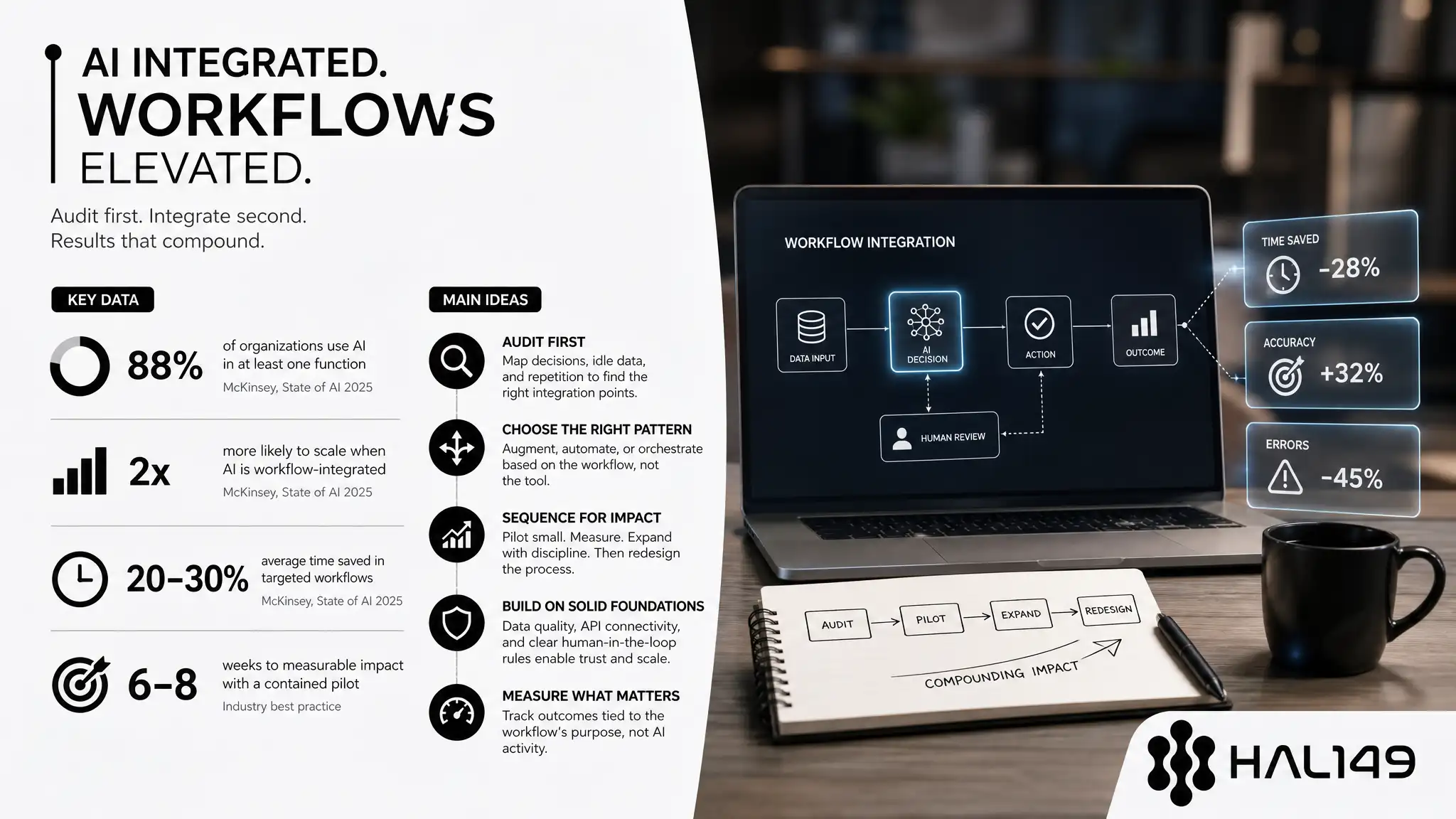
Integrating AI into existing workflows works best when you start with a process audit, not a tool selection. Map where decisions stall, where data sits idle, and where repetition drains capacity, then build or connect AI to those exact points. Most companies that struggle with AI adoption skip this step and end up with tools that run beside their workflows rather than inside them.
Why Most AI Integrations Stall before They Deliver
The gap between "we're using AI" and "AI is measurably improving our operations" is wide. According to McKinsey's State of AI 2025, 88% of organizations now use AI in at least one business function. Yet the same report makes clear that most firms are stuck at early-stage deployment and struggle to scale across the enterprise.
The reason is almost always the same: AI was chosen before the workflow was understood. Teams adopt a generative tool or an automation platform and then look for places to plug it in. That sequence produces friction, the tool solves a problem the business did not have, or solves a real problem in a way that bypasses the existing system rather than improving it.
The fix is to reverse the sequence. Understand the workflow first. Then decide what kind of AI belongs in it.
The Process Audit: Where Integration Actually Starts
A process audit for AI integration asks three questions about each workflow under review.
First: where does the process wait on a human decision that could be supported or automated? These are the handoff points, approvals, classifications, prioritizations, where a trained model can act with or without human oversight.
Second: where does data exist in the process but go unused? Most business systems generate far more signal than they act on. Idle data is the raw material for prediction, recommendation, and anomaly detection.
Third: where does a person repeat the same task with slight variations? Not every repetitive task is worth automating, but those that sit on the critical path, where volume is high and errors are costly, are strong candidates.
Once the audit is complete, you have a ranked map of integration opportunities, not a wishlist of features.
💡 Prioritization rule: Score each candidate workflow on two axes: frequency (how often it runs) and consequence of error (what goes wrong when it fails). High-frequency, high-consequence workflows are the right first targets. Wins there are visible, measurable, and they build internal confidence for the next phase.
Choosing the Right Integration Pattern
Not all AI integrations look the same. The pattern you choose should follow the structure of the workflow, not the capabilities of a vendor's demo.
Augmentation places AI alongside the human, providing recommendations, drafts, or flags that the person acts on. This works well where judgment is irreducible but where the cognitive load of gathering and synthesizing information is high, sales prioritization, customer support triage, procurement review.
Automation removes the human from routine execution entirely. It is appropriate where the decision rules are stable, the inputs are structured, and the consequences of an error are bounded and reversible. Invoice matching, data formatting, report generation, and scheduling are typical examples.
Orchestration connects multiple automated steps and decision points into a coherent flow, often involving AI agents that hand tasks between systems without manual intervention. This pattern is more complex but delivers the highest efficiency gains when multiple departments share a single end-to-end process.
Research from MIT Sloan argues that AI's biggest organizational impact comes not from task-level automation but from how it reshapes the way tasks are sequenced, grouped, and handed off. The implication for integration: think in workflows, not in individual tasks.
How to Sequence the Rollout
Integration sequencing matters as much as the integration itself. A parallel approach, running the AI system alongside the existing one before cutting over, reduces risk and generates the comparison data you need to validate performance.
Phase one is a contained pilot: one workflow, one team, clear success metrics defined before you start. The goal is a measurable result within six to eight weeks, not a proof of concept that runs indefinitely.
Phase two is instrumented expansion: apply what worked to adjacent workflows or departments, carrying the same measurement discipline. Avoid the temptation to expand too broadly before the first integration is stable.
Phase three is process redesign: once AI is embedded and trusted, the workflow itself can be redrawn. Steps that existed to compensate for human limitations (double-checking, manual reconciliation, status-update meetings) can be removed rather than automated.
What the Infrastructure Has to Support
AI integration places real demands on the systems it touches.
Data quality is the most common bottleneck. A model is only as useful as the data it is trained on or queries against. Before integration, the relevant data needs to be accessible, consistent, and governed. Siloed systems, inconsistent field formats, and missing historical records each reduce what AI can do.
API connectivity determines how AI components talk to existing tools. Where APIs are clean and documented, integration is straightforward. Where they are absent or poorly maintained, integration requires an intermediary layer, or a different integration pattern.
Human-in-the-loop design specifies which decisions require human review and under what conditions AI output can be acted on directly. This is not just a risk management question; it is a workflow design question. The clearer the rules, the faster the system operates and the more trust the team places in it.
Measuring Whether It Is Working
An AI integration without a measurement plan is just an experiment with no end date.
The metrics should be tied to the workflow's original purpose, not to the AI system's activity. A customer support automation should be measured by resolution time and escalation rate, not by the number of queries the model handled. An AI-assisted sales process should be measured by conversion rate and cycle time, not by how many leads the model scored.
Track a baseline before you deploy. Without it, any improvement you observe is directionally useful but numerically unconvincing, which matters when you are making the case for the next phase of investment.
More updates
· Engineering
The Case for AI-Native Companies
AI-native companies produce roughly 100x the output of legacy firms that adopt AI on top of old hierarchies. Here is why organizational design, not software, is the deciding factor.
Read update · 6 min read
·
GTM Engineering and Growth Engineering Are Not the Same Role
GTM engineering automates revenue systems outside the product. Growth engineering runs experiments inside it. Here is where each discipline starts and stops.
Read update · 3 min read
· Product
Design of a webapps factory as a separate project
Design work on a factory for small, niche web apps. Two conclusions: it has to be a separate product from our client platform, and the slow part is not the code.
Read update · 1 min read