· 6 min read · Analysis
AI Platform API Comparison Report 2026
As of July 2026, every major AI platform API, Claude, OpenAI, Gemini, Perplexity, and Grok, supports real-time web access. The last holdout, Google Gemini, joined with the Gemini 3 family's Grounding with Google Search capability. Web access is now a baseline, not a differentiator. What differs sharply across platforms is how that access is priced and structured.
How Each Platform Implements Web Search
Each of the five platforms takes a different architectural approach to live retrieval, and that choice shapes both cost and output quality.
Claude (Anthropic) exposes web access through two discrete tools in its API: web_search and web_fetch. The first runs a search and returns results with automatic citations; the second fetches a specific URL directly. Search is billed at a flat $10 per 1,000 queries on top of standard token costs. Anthropic's official web search documentation covers both tools in full.
OpenAI integrates web search via a dedicated tool available across its model range. Retrieved content is billed at the model's standard token rates, there is no separate flat search fee, which makes cost modelling simpler but harder to predict at volume. The OpenAI web search guide covers the implementation.
Google Gemini introduced Grounding with Google Search on its Gemini 3.x family in 2026, the biggest structural change in this space since last year. The Gemini 3.x tier gets 5,000 grounded prompts per month at no charge, then $14 per 1,000 grounded queries. Legacy Gemini 2.5 grounding runs higher, at roughly $35 per 1,000 prompts. Full details are in the Gemini grounding documentation.
Perplexity is the only platform where web search is not a bolt-on: all Sonar models include real-time retrieval by default, with citations. Search fees are charged per request on top of token costs, scaling with how much retrieved context the model processes, roughly $5 to $12 per 1,000 requests for base Sonar and $6 to $14 per 1,000 for Sonar Pro. Pricing details are at docs.perplexity.ai.
Grok (xAI) calls its capability Live Search, covering real-time web content and X/Twitter posts. Live Search, X Search, and Code Execution are each billed at $5 per 1,000 calls. A prompt that crosses 200K tokens doubles the base model rate, worth noting for long-context agents. The xAI Live Search guide covers rate limits and integration details.
💡 Budgeting tip: Most platforms meter web search as a per-1,000-call fee separate from tokens. Model those calls explicitly in your cost projections, a workload making 10 searches per user session at scale can dwarf the token cost in the same invoice.
The 2026 Pricing Landscape
Token prices have dropped materially from 2025 levels across the board. The flagship tier that cost $15 per million input tokens in 2025 sits at $5 per million in 2026. Mid-tier models keep compressing further. Search costs remain the more stable line item.
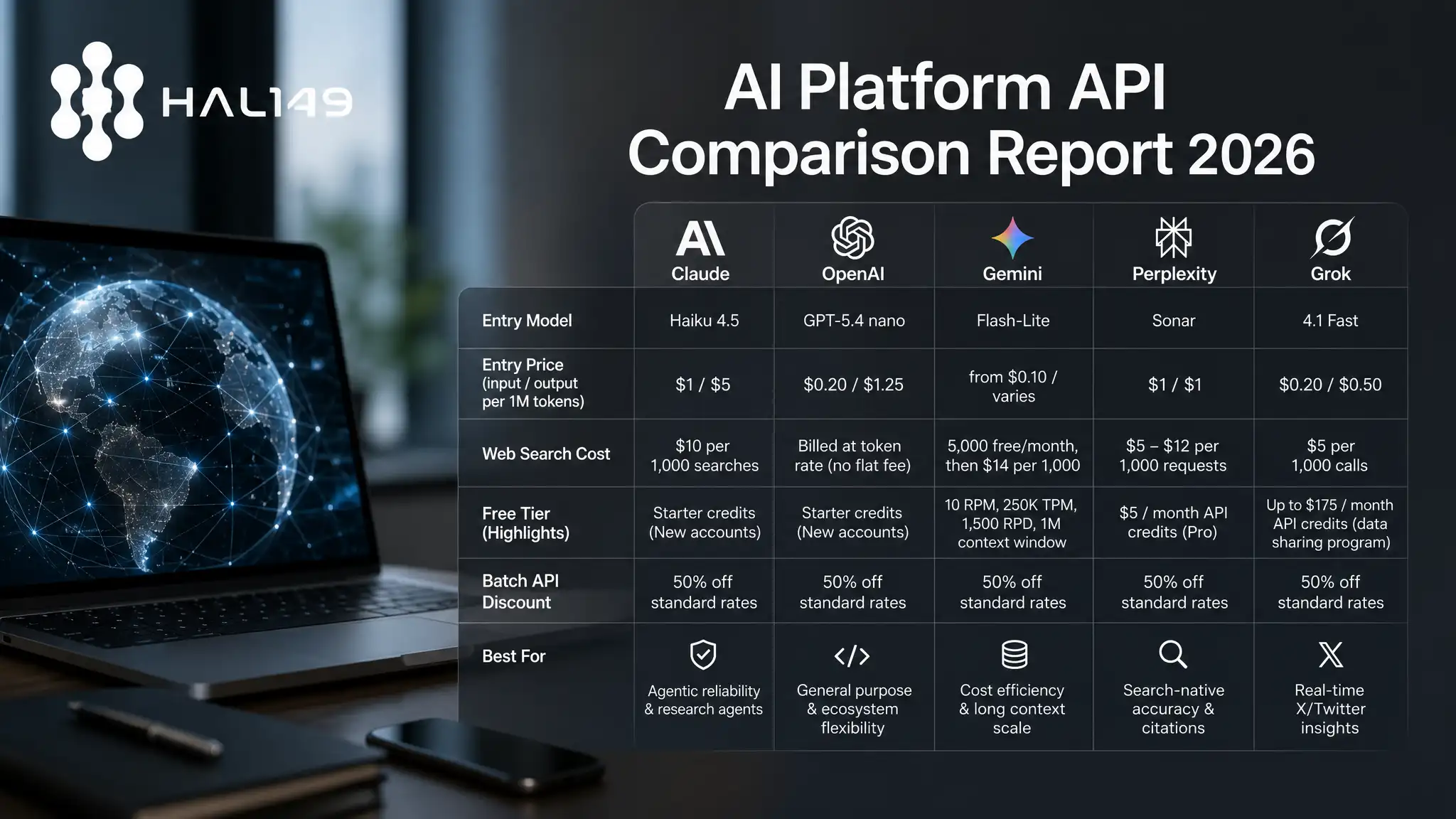
| Platform | Entry Model | Entry Price (input/output per 1M tokens) | Web Search Cost |
|---|---|---|---|
| Claude | Haiku 4.5 | $1 / $5 | $10 per 1,000 searches |
| OpenAI | GPT-5.4 nano | $0.20 / $1.25 | Billed at token rate (no flat fee) |
| Gemini | Flash-Lite | from $0.10 / varies | 5,000 free/month, then $14 per 1,000 |
| Perplexity | Sonar | $1 / $1 | $5, $12 per 1,000 requests |
| Grok | 4.1 Fast | $0.20 / $0.50 | $5 per 1,000 calls |
All five platforms offer a Batch API at 50% off standard rates, and prompt caching (where available) bills cache hits at roughly 10% of the input rate.
Free Tiers and Entry Points
Gemini holds the most generous permanent free tier by a clear margin: 10 requests per minute, 250,000 tokens per minute, and 1,500 requests per day with a 1 million-token context window, covering the Flash and Flash-Lite models. No other platform in this report offers a usable ongoing free tier at that scale.
Claude and OpenAI offer small starter credits for new accounts, but neither maintains a permanent free tier for API use. Perplexity Pro subscribers receive $5 per month in API credits. Grok offers up to $175 per month in free API credits via its data-sharing programme, though that is conditional rather than unconditional.
How the Platforms Differ beyond the Baseline
Web access being universal now shifts the question from "can it search?" to "what does it do with what it finds?" The five platforms have meaningfully different strengths.
Perplexity is the only one built ground-up as a search-native model: every Sonar response is grounded in retrieved content, and citation accuracy has been the platform's primary design goal. It is the natural fit for applications where factual precision and source attribution are the product itself, research tools, fact-checking pipelines, news aggregation.
Grok's Live Search gives it exclusive access to X/Twitter posts in near-real-time, which no other API in this group provides. For social listening, trend detection, or any workload that treats X content as a primary data source, that is a structural advantage.
Claude's web search is designed for agentic reliability, consistent citations, predictable tool-call behaviour, and a separation between search and direct URL fetch that suits multi-step research agents. Anthropic publishes its agent architecture guidance as part of its main API documentation.
OpenAI covers the widest general-purpose ground: GPT-5.5 with web search handles complex reasoning over current data, and the 5.x line's breadth of fine-tuning and function-calling support makes it the default choice for teams already invested in the OpenAI ecosystem. Model names in the 5.x line refresh frequently, the OpenAI pricing page is the reliable source for the exact variant names at any given time.
Gemini wins on cost efficiency and scale. Flash-Lite is among the cheapest per-token options available, the free grounding tier is a genuine testing resource, and the 1 million-token context window makes it competitive for long-document workloads. The Gemini 3 Pro tier scales pricing with context size, so that one bears closer attention for long-context production use.
What This Means for AI Integration in 2026
The convergence on web access as a standard feature resolves one of the key integration questions from 2025: choosing a platform no longer means choosing whether your AI can access current information. It means choosing how you want that access structured, at what cost tier, and with what specialisation.
Search fees are now a distinct line item in any realistic AI budget. Token costs have fallen far enough that, for search-heavy workloads, the per-query fee often exceeds the token cost of the response itself. That inversion is new in 2026 and worth building into any API cost model before committing to an architecture.
Model lineups and rates in this space move quickly. The figures here reflect the state as of July 2026, verify current rates on the official documentation for each platform before production deployment.
More updates
· Engineering
The Case for AI-Native Companies
AI-native companies produce roughly 100x the output of legacy firms that adopt AI on top of old hierarchies. Here is why organizational design, not software, is the deciding factor.
Read update · 6 min read
·
GTM Engineering and Growth Engineering Are Not the Same Role
GTM engineering automates revenue systems outside the product. Growth engineering runs experiments inside it. Here is where each discipline starts and stops.
Read update · 3 min read
· Product
Design of a webapps factory as a separate project
Design work on a factory for small, niche web apps. Two conclusions: it has to be a separate product from our client platform, and the slow part is not the code.
Read update · 1 min read