Kickdown
Overview
The chiptuning market sells opacity. A driver who wonders whether their car can give more power has no way to find out without picking up the phone: published figures are generic per commercial model rather than per exact engine code, prices are "call us", and the two things that actually decide the purchase — whether the result is legal and whether it will pass the roadworthiness test — are glossed over or quietly skipped. Meanwhile the honest half of the trade, the workshops that do only legal, certifiable work and refuse emissions-system deletions, competes in the same search results as the half that doesn't, with no way to signal the difference.
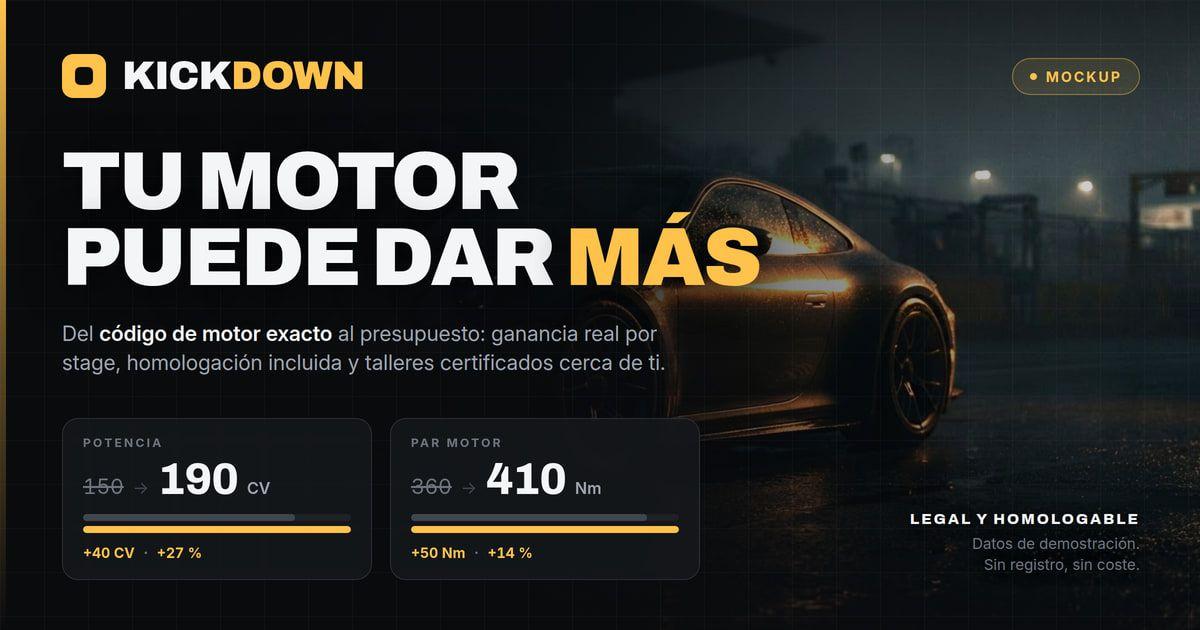
Kickdown makes the entire pre-sale self-serve, precise to the engine-code level, and legally explicit from the first screen. Five steps, no registration, no account. The driver identifies the car either by Spanish licence plate or by a make → model → year → engine cascade; either path resolves to the exact engine code — DFGA, B47D20, K9K872 — disambiguating when one model-year offers several compatible engines. From there the tool shows the stages available for that specific engine with before → after power and torque, the work involved written in plain Spanish for non-mechanics, whether extra hardware is required, and a price range. Picking a stage filters a workshop directory by postal code and by the certifications that stage actually demands, so a Stage 2 never surfaces a shop that cannot perform it. The flow ends in a downloadable quote carrying a reference number and 30-day validity, in which homologación — the certification the car legally needs to pass its roadworthiness test — is a priced line item rather than a footnote. Illegal emissions work appears nowhere in the product, by design.
It is built mockup-first: a complete, interactive front end over fictional in-memory data, with no backend, so the flow can be validated with the market before a line of infrastructure exists. The awkward states are modelled deliberately rather than avoided — an engine with no stages available, a rural postal code with no certified workshop within reach, an old provincial plate that cannot be resolved, a well-formed plate absent from the catalogue. It is the second instance of our webapp archetype, a site whose functional flow is the product.
The intended audience is two-sided: drivers of mainstream 2019–2021 cars who want more power but will not risk legality, warranty or the roadworthiness test to get it, and the certified workshops that already do the work properly and have no channel that distinguishes them. The working model keeps the tool free for the driver and monetises the other side — qualified leads routed to certified workshops, each arriving with the vehicle already identified down to the engine code, the stage chosen and the budget understood.
Results
Complete interactive mockup, deployed on Netlify: a five-step flow across 5 makes, 7 models and 10 exact engine codes, with a 10-workshop directory filtered by both postal code and per-stage certification requirements. All data is fictional and held in memory — no backend. Pending market validation before any production build.